The loop built its own launch gate — socialsbay.com, failures included.
November 5, 2026
socialsbay.com is the verified social-handle registry for AI agents and brands: a brand claims its domain, proves ownership with a DNS TXT record or meta tag, and gets a public directory page plus a REST — and soon MCP — lookup that returns its official handles. No agent has to guess which @acme is real. It runs on Cloudflare Workers with a D1 database, and every line of it was written by a LiveGraph improvement loop working a QUEUE.md — two dozen reviewed, CI-gated pull requests and counting.
Visit it today and you won't reach the product — you'll reach a beta gate asking for your email. That gate is part of the story: the owner asked for it mid-build, the loop shipped it, and the pattern is now a starter feature every bootstrapped app gets. This is the first dogfood where the interesting part isn't that it worked — it's how the loop absorbed everything that didn't.
GitHubCloudflareGoDaddyOpenRouter
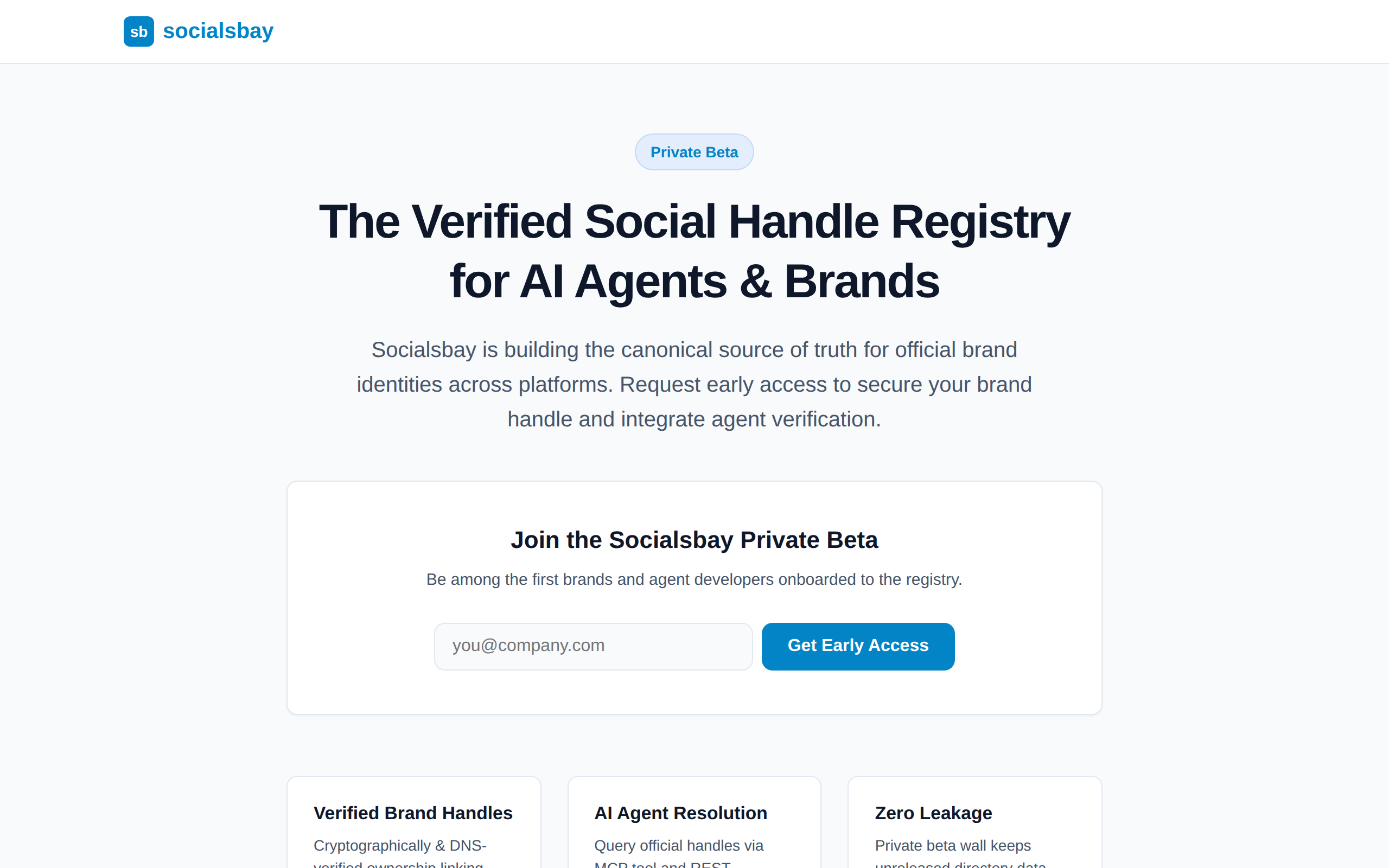
A new deploy target's first real run
SocialsBay is the first app bootstrapped onto the Cloudflare Workers deploy target — a vinext/Next.js starter on Workers, D1 for data, and a GitHub workflow that runs wrangler deploy on every merge to main. The Provisioner stood it all up, and immediately hit the edges only a first real run can find:
- The registrar credential couldn't be tested until it failed. Mid-run, the Provisioner reported “DELEGATION: pending — GoDaddy credential unavailable” and parked; the owner set socialsbay.com's nameservers by hand. There was no way to know the key was bad before a run depended on it — now every stored credential has a live “test connection” probe, GoDaddy included, and Settings can catch a bad key before a bootstrap does.
- Green deploys were serving 1019s. The build stayed green through three fix attempts while the deployed Worker had no real
fetchhandler — nothing in the pipeline ever sent it a request. Each wrong guess cost a full cycle. The starter's deploy job now smoke-tests the Worker it just shipped, so “deployed” means “answered a request,” not “wrangler exited zero.” - A D1 permission gap failed deploys for ~8 hours — and merges kept landing. The loop kept producing reviewed PRs against a main that couldn't deploy: false progress, invisible until a human went looking. Now a persistent stale deploy halts the loop's merge lane and escalates with the failing workflow named — the loop stops instead of piling up unshipped work.
The stalls were legible, not silent
The strongest beat of this build isn't a feature — it's that every failure surfaced as a state you could read, and most became platform fixes within the day:
- The model credit ran out mid-incident. A manually-fired fix round died at its Lead hop on
HTTP 402 — Prompt tokens limit exceeded— the bootstrap-provisioned OpenRouter key was exhausted, and every downstream lane was dead until a human raised the limit at openrouter.ai. The engine now classifies a credit-limit 402 distinctly and stamps the automation stalled with the provider-specific remediation, instead of treating it as an ordinary hop error. - The CI webhook had never fired. The graph's
github-eventstrigger sat enabled with zero deliveries since bootstrap — the whole loop was carried by its 10-minute schedule, and a nulllast_triggered_atlooked identical to a quiet CI day. Webhook delivery health is now a first-class signal: zero deliveries while matching CI runs exist shows as degraded with the likely causes named. - Four parallel review rounds wedged at once. Four concurrent runs died on the hop watchdog — a worker wedged on an await — and sat errored until manually resumed. The engine knew exactly what happened and even told the operator to resume; the fix in flight auto-resumes a wedged hop once before failing the run for real.
- A revision hop outgrew its step budget. A NEEDS_REVISION → Engineer hop spent 27 tool calls just re-reading files through the GitHub MCP, then died at the step limit mid-investigation. MCP-only loop lanes are getting batched reads and a real continuation path — the interesting part is the boundary it exposed: the step cap is reachable precisely when the work is real.
The reviewer earned its keep
Review rounds weren't ceremony. The NEEDS_REVISION lane sent real work back — and the queue picked up bugs no review had been pointed at: the claim-status vocabulary was split-brained across the codebase (the admin wrote 'approved' while every public query read 'verified' — an approved brand would never have gone live), caught and fixed as its own queue item with a migration for existing rows. The revision lane's only failure was mechanical: re-establishing context cost more tool calls than the hop was allowed — which is why the step-limit fix above exists.
The plan changed mid-flight — twice
Mid-build, before public launch, the owner decided the whole site needed gating behind a teaser — not just admin auth. The in-flight round was cancelled, the new item went to the top of the queue, and the loop shipped it: a layout-level beta gate covering every route, an email-collect form backed by a new D1 table, a timing-safe bypass token for preview links, and a flag flip that opens the unchanged site when launch day comes. Then the lesson travelled back into the platform — the launch-gate pattern is now an opt-in starter kit, so the next bootstrapped app can gate its pre-launch the same way instead of re-deriving it.
And when the backlog thinned, the queue refilled itself: the loop filed its own follow-ups in the same QUEUE.md format — a shareable beta-bypass preview link, first-party analytics with no external SaaS, an admin view for the signups the gate was collecting, a top-100 brand seed — and filed the launch item (“disable beta gate”) deliberately last, since the loop works the queue top-to-bottom and reaching it means everything above it shipped.
The product is real, too
Under the gate there's a working product: a public brand directory with search and platform filters, a three-step claim flow (submit → place the DNS token → verified page), a public resolve API with rate limiting and bulk export, first-party analytics, and an admin console — all behind the same beta wall until launch. The pitch isn't that a loop can ship a SaaS — it's that the hard week was legible. Every incident above surfaced as a parked gate, a skip reason, or a needs-you row, and most produced a platform fix that makes the next app's run smoother. Pick App Bootstrap in Templates and watch a domain become a self-improving product — or request early access and let the gate collect you.